

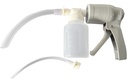

MANUAL SUCTION UNIT, disposable canister & tubing

Valid Article


 OC subscriptions: included in supply or field order tools (e.g. UniField)
|
|
 SC subscriptions: included in supply or field tools
|
|
 OC validations: approved for procurement and use by an OC for international or local orders specifying context and activity in Medical Standard Lists (MSL)
|
|
Manual Suction Unit VBM
Definition
A portable assembly of devices, which includes an orally-introduced handpiece/tip, intended to manually aspirate unwanted materials (e.g., fluids, secretions) from the airway typically during patient transport or an emergency situation (e.g., placed on a crash cart). In addition to the handpiece/tip, it includes a manually-powered hand operated suction pump, a collection container, and microbial/hydrophobic filters.
The system is not intended for surgical use.
Specifications
a) Vacuum pump
b) Sealing cap
c) Suction cap
d) Container 250 ml
e) Suction catheter 28 Fr
f) Suction catheter 40 Fr
g) Adapter for standard suction catheter
h) Standard suction catheter (Not part of the package)

Technical specifications
Vacuum pump: reusable
Accessories: disposable: suction catheters (CH18 and CH 40), container 250 ml, sealing cap, adapter for regular suction catheters, suction cap)
Non sterile device
Max. achievable vacuum: 480 mmHg
Vacuum pump dimensions: 155 x 55 x 180 mm
Weight REF 30-55-000 (incl. packaging): 470 g
To be Ordered Separately
The Accessory Kit for Manual Suction Pump is intended for single use and must not be reused and/or reprocessed
Instructions for use
- Select the suction catheter according to the use and connect it to the suction cap or connect the adapter for standard suction catheter to the suction cap. Then connect a standard suction catheter.
- To prevent fluids from contaminating or obstructing the vacuum pump, the container must be kept as upright as possible.
- Operate the vacuum pump handle.
- As soon as suctioning is complete, carefully remove the suction catheter from the patient's oral cavity or pharynx.
- Disconnect the filled container from the vacuum pump and disconnect the suction catheter from the suction cap.
- Unscrew the suction cap from the container and cover with the sealing cap.
- If a lab test is required, the sticker on the container must be labelled.
Precautions for Use
Visual and Functional check before using the device:
- Check the product for damages and loose particles.
- Check whether a vacuum is generated:
- Seal the opening of the suction cap with your thumb or palm of your hand.
- Operate the vacuum pump handle several times. This allows you to determine if a vacuum is generated.
Maintenance
Wipe disinfection must be performed with commercially available surface disinfectants based on alcohol, QACs (quaternary ammonium compounds) or hydrogen peroxide. When choosing a product for disinfection, a disinfectant with appropriate ranges of action must be used: bactericidal, yeasticidal and virucidal. After wipe disinfection, inspect the vacuum pump for visible contamination. If necessary, repeat wipe disinfection. After wipe disinfection, check the function of the vacuum pump
The vacuum pump must not be mechanically or manually reprocessed or sterilised.
Storage
- Protect from heat and store in a dry place
- Keep away from sunlight and light sources
- Store and transport in the original packaging.
MSF requirements
1)The standard default suction pump should be the standard electric powered one that has battery backup. EEMDPUME4--
Including for vehicles where DC power can be delivered and the need for suctioning during transport can be anticipated (eg. ambulance, facility to facility transfer, etc)
2)The need for an emergency, manual pump would be better met for situations such as an emergency medical bag where a patient being transported may need emergency airway suctioning, and that for this a hand operated pump is preferred since it's not possible to effectively operate a foot pump in a moving vehicle and something compact enough to fit in a medical emergency bag would be advantageous.
![[EHOEPUMC410] (VBM manual suction), set consumables 30-56-000](/web/image/product.template/589494/image_256/%5BEHOEPUMC410%5D%20%28VBM%20manual%20suction%29%2C%20set%20consumables%2030-56-000?unique=111d5f2)